These two lectures were spent featuring historical uses of data visualisation during major events.
Napoleon’s Invasion of Russia (1812)
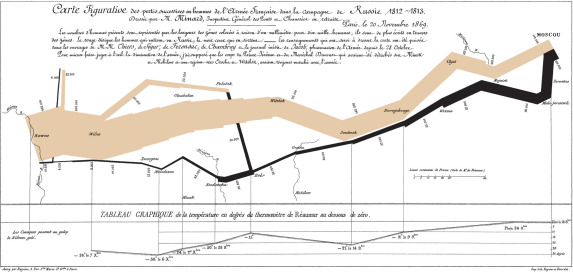
It started with Napoleon’s invasion of Russia. Charles Joseph Minard’s infographic illustrating Napoleon’s forces throughout before and after the invasion.
Crimean War (1858)
Florence Nightingdale was a nurse during the Crimean War, and realised soldiers were dying due to malnutrition, poor sanitation, and lack of activity. As she sought to improve living conditions she kept records of the death toll to show the importance of patient welfare. She then turned these records into graphs to put together an argument to the British military commanders.
Both her original monograph and a modified, more simple version were shown:
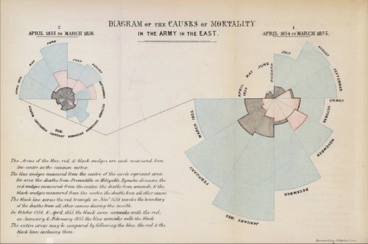
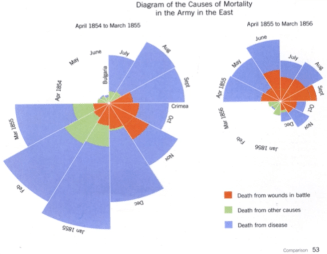
These graphs revealed the biggest threat to the troops was disease, thus improving the sanitary standards of hospitals.
In these graphs, the area of spaces are being compared. Though the graph was effective with the use of sectors, the lecture shows that it would be more effective as a bar graph in comparing the causes of death.
Otto Neurath (1882-1945)
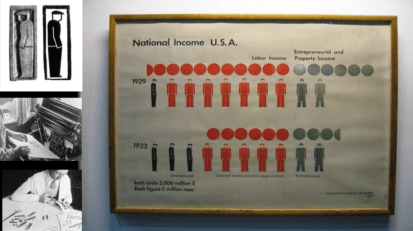
Neurath was a pioneer in socialist politics and economics in Vienna. His starting point for graphical development was a museum in Vienna, called the Museum for Society and the Economy, in 1924. The museum’s mission was to make social and economic relationships understandable, especially for the uneducated. It visualised hidden economic factors that underly the functioning of society. Neurath believed visualisation was education through the eye and would greatly impact and influence the masses.
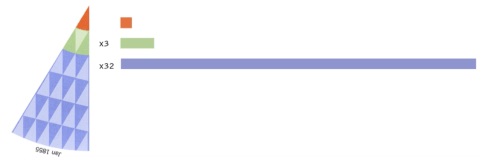
A new system was developed called ISOTYPE (International System Of TYpographic Picture Education). It introduced the serialisation of images, where instead of scaling the images to indicate higher value multiples of same-sized graphics were used.
The second part of the lecture looks at Alberto Cairo’s book: The Functional Art: An introduction to information graphics and visualisation. Cairo had read an article about the world’s population and conflicting ideas of fertility rates in each country. While some had suggested a presence of rising fertility in poor regions contributing to the rise of the world’s population, others focused on the ageing population in developed countries where fertility rates were below 2.1 children per woman, which is the replacement rate of the world’s population, as the problem.
Cairo contradicted these two theories by discussing two trends:
-
- fertility rates in rich countries were going up, and;
- fertility rates in poor countries were decreasing.
He then looked at data of fertility rates around the world from the past century, focusing on Spain and Sweden in particular.
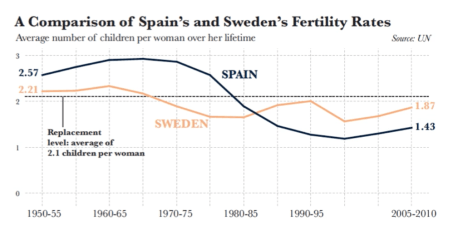
By taking the data and placing them in a graph, Cairo was able to view the trends that differentiated the fertility rates in these two countries with ease.
Through this example, it is shown that by visually-encoding data, graphs save readers time to calculate trends themselves through a table.
We were then left with the message that we must aim to produce “functional art” that not only is engaging and pleasing to the eye, but acknowledges the intelligence and curiosity of readers.
Images:
Cmielewski, L (2015). Visualisation: Historical and contemporary visualisation methods [Online lecture]. Retrieved 25 July, 2019.

