This lecture pod introduced four main types of data:
-
- nominal
- ordinal
- interval
- ratio
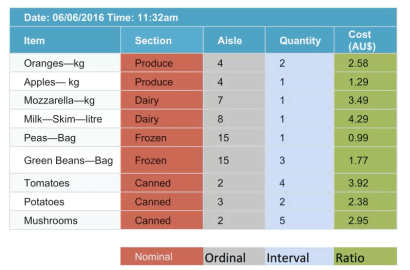
Throughout each type of data was used in a supermarket scenario.
Nominal data are known as named categories and are unordered. They can be counted and can calculate percents but cannot take an average.
-
- Two categories of data is known as dichotomous data, such as yes or no questions.
- Supermarket example: The number of items in the basket belonging to separate categories (such as canned, dairy, and produce)
Ordinal data is naturally-ordered, so it goes up and down on scales.
-
- An example would be survey answers going from “strongly agree” to “strongly disagree”. Though they may be given numerical values from one to five, these have no mathematical value.
- Supermarket example: Determining which queue is the shortest by visualising different-sized lines and placing them in order from shortest to longest.
Interval data is named as such since every interval between each consecutive point of measurement is equal.
-
- There is no meaningful zero point, zero (0) does not indicate the absence of the variable being measured (such as temperature and years)
- Interval data is numeric, so mathematics can be applied.
- Supermarket scenario: Checking the current time to the time you entered the supermarket (11:30-12:00 has the same value as 1:00 to 1:30).
Ratio data is similar to interval data except for the fact zero indicates absence of variables.
-
- Examples include weight and height
- Supermarket scenario: Minutes waiting in line
All types of data were then summarised in a table which was based on the supermarket scenario.
The lecture ended on diagrams that organised the types into different categories:
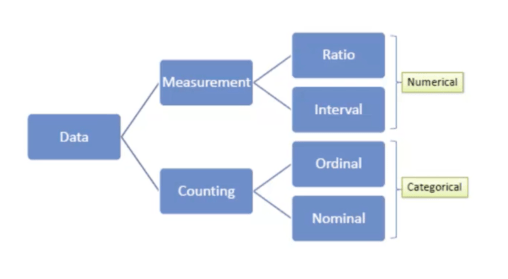
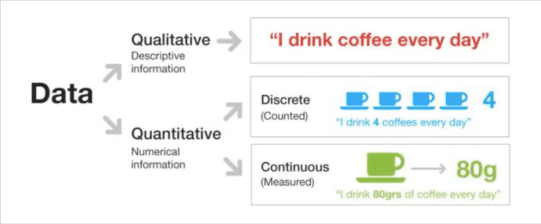
Moving forward in this unit, it is important we understand the types of data we will be taking and how to categorise them. This enables us to convey stories through data in a meaningful and coherent manner.
Images:
Waterson, S. (2015). Data Types [Online lecture]. Retrieved on 23 July, 2019.

