This weeks lecture pod consisted of three videos about data journalism at The Guardian. They are the pioneers of data journalism and the first bloggers of data online, so being able to see their views on data is quite profound.
The first video shows employees at The Guardian answering what data journalism is to them. Here are a few of their answers:
-
- Journalism was about conjuring images with words, but now it is about telling stories using data
- It is the use of key information sets to inform a story
- It is important the audience reading the information will understand the story being presented
- It is the modern way of journalism, which was once known as the least-trusted profession. Now stories are backed by facts and figures.
The second video shows the history of data journalism at The Guardian, presented by Simon Rogers who is an author and editor of The Guardian Datablog, who says that The Guardian has been using data since its first issue in 1821 and that they are about presenting ideas and bringing stories to life for the readers.
-
- Its first issue had a table of data with a list of schools in Manchester and how many boys and girls attended. This was before compulsory education and was highly political. It was an example on the importance of data to be presented to show what was going on in the world so things could improve.
- The earliest representation of data was in an edition in 1901, showing South African tactics in the Boer War.
- Another graph was shown in the Manchester Guardian Commercial in 1938, which uses a proportional stack chart:

- This highlights the importance of using colour in modern technology; previously graphs relied on different cross-hatching to differentiate sections of the graph.
- This video shows that The Guardian introduced representing complicated data in an easily-understood visual way, now venturing into digital graphs.
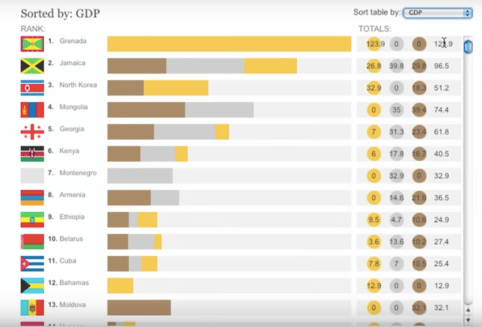
The third video, titled ‘Data Journalism in Action: The London Olympics’ shows The Guardian’s role in presenting medal counts for every country during the 2012 London Olympics, and in particular, combining this data with other types of data (population, team size, GDP). Simon Rogers explained the significance if a poorer country won just as many medals as a richer country, and wanted to open talks as to why they are not recognised.
-
- Getting help from Professor Christoforus Anagnostopoulos, an academic statistician from Imperial College London, they opted for an interactive that could be interpreted as a medal count.
- The final design opened worldwide conversation of why certain factors are the way they are, such as why some countries are better at running than others, or how one country is over-performing above their weight when you look at its economics or the size of its population.
- Rogers’ favourite aspect was that it allowed people to explore the set of data, saying it “marked out data journalism”. Rather than regular journalism where maybe only the top countries were focused on due to the constraint of words, this graph allowed all countries to be compared and contrasted.
These videos show The Guardian’s role in innovating data journalism. It gives us information on how data visualisation can help visualise public trends, but it also shows us how visualisations have been used in different historic contexts, providing us precedents for our own sets of data we may decide to visualise.

